The whole timetable lives on your phone. Plan a journey in a tunnel, check the board on a packed platform, and never watch a spinner while a train pulls away.
No sign-up. No ads for your data. Works the moment it finishes installing.
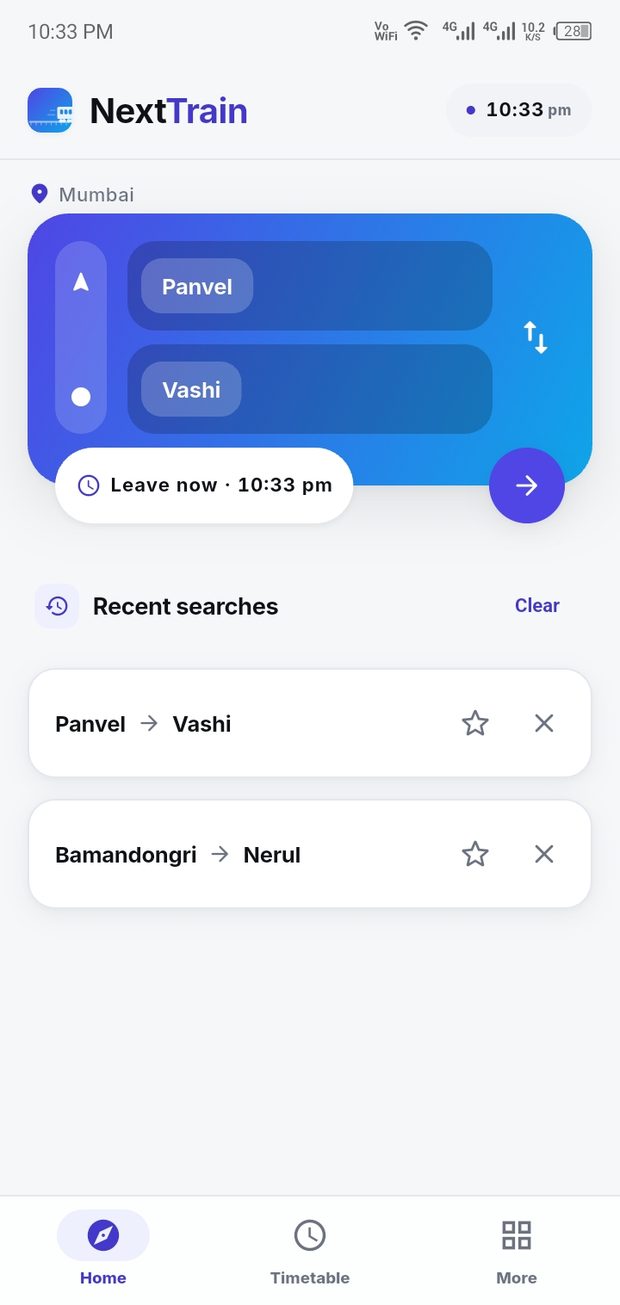
Built around the two questions you ask on a platform — when is the next one, and will I make it — and nothing that gets in the way of answering them.
Pick two stations and get real departures, arrival times, interchanges and which line to board — ranked fastest first.
Every train leaving your station, counted down in minutes, with platform, train number and fast/slow/AC filters.
Set an alarm against a specific train. It rings before you need to leave, whether or not the app is open.
Suburban and metro network maps you can pinch and read, plus a line-by-line browser with every stop in order.
Bus routes, ferry timings, ticket and pass fares, penalty rules and emergency numbers — the reference you normally go hunting for.
Megablocks, diversions and disruptions pushed straight to your phone, and kept in the app so you can read them again.
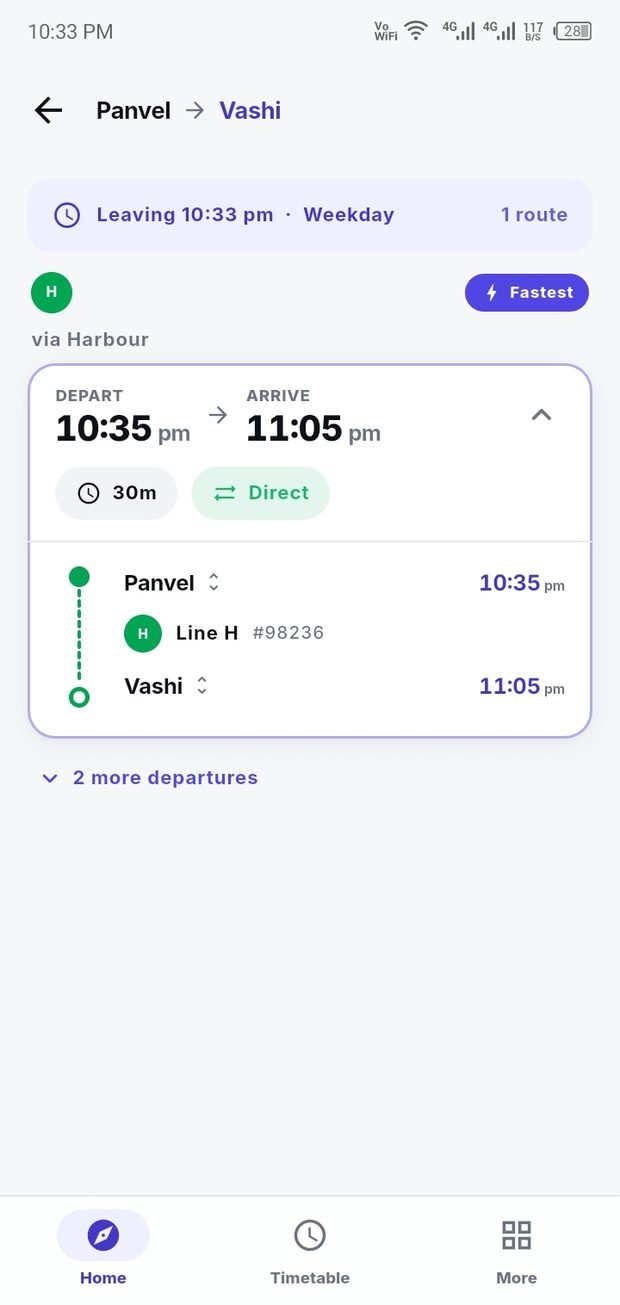
Departure, arrival, duration and whether it is direct — before you pick a platform.
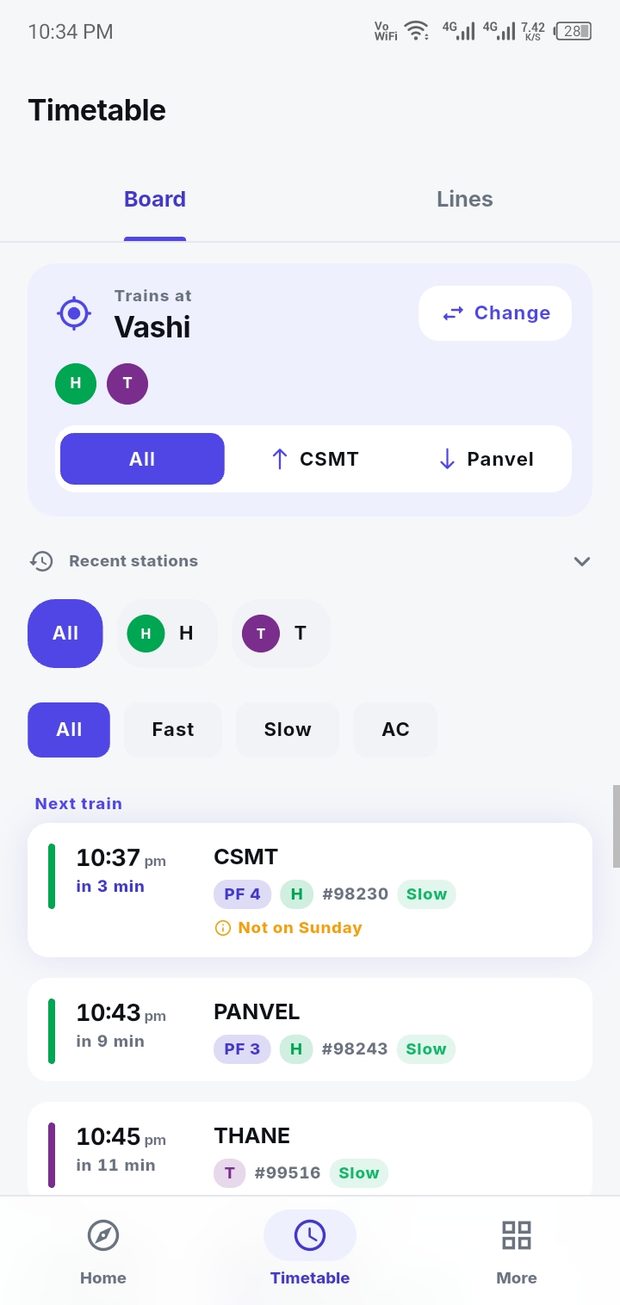
Next trains at your station, counted down, filtered by direction and by fast, slow or AC.
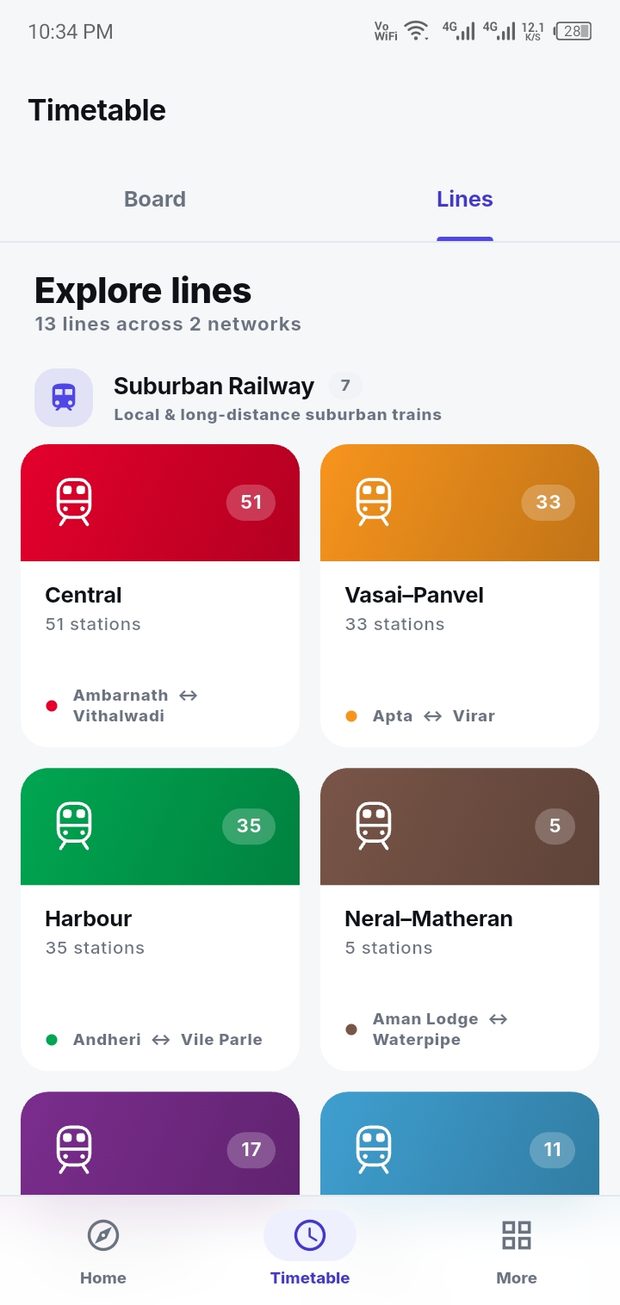
Browse every line and its stations, across suburban railway and metro alike.
Most transit apps are a website in a wrapper — lose signal and you lose the timetable. NextTrain ships the timetable inside the app and reads it from your own phone, so the answer arrives instantly whether you have five bars or none.
Switch city inside the app — there is no separate install and no second icon on your home screen.
Western, Central, Harbour, Trans-Harbour, Vasai–Panvel, Neral–Matheran and the metro lines.
Delhi Metro across the full colour-coded network, with interchanges handled by the planner.
Pune Metro and the local railway corridor, with the same board and planner as everywhere else.
Every timing above is read from the copy of the timetable on your phone, so a Harbour line departure board and a Delhi Metro route both answer instantly with no data connection.
The questions people actually ask, answered in plain words.
No name, no email, no phone number and no sign-in of any kind. Your stations, recent searches, favourites, reminders and language setting are stored on your device and are never uploaded.
The app does not request location permission. You choose your station from a list; nothing follows you between them.
Two things. A check for a newer timetable, which sends only the version number you already have. And — if you allow notifications — an anonymous device token from Google so service alerts can reach you. It is not tied to any identity and you can turn notifications off in Android settings at any time.
Yes, a small number of ads from Google AdMob keep the app free. They are served by Google under its own policy; nothing about your journeys is shared with advertisers.
Published operator timetables, compiled into the app and refreshed when the networks change. Timings are indicative — always allow for real-world delays.
Yes. The entire timetable ships inside the app and is read from your own phone, so journey planning and departure boards work underground, in a basement, or with no data balance.
Yes, completely free to download and use on Android. It is funded by a small number of ads rather than a subscription.
Free, offline, and about the size of a few photos. Install it once and stop refreshing.
 Next
Next